Aurora goldmine
The LuminariesThe Aurora goldmine is a claim at Kaniere whose apparent decline conceals a chain of disputed ownership, labor, and hidden gold. Its name becomes a label applied to wealth that did not originate in the mine, while Staines’s failure to account for the gold leaves the claim’s production and fortunes entangled with a much wider mystery.
Setting and land
The mine is identified with Kaniere, within the West Coast goldfields. Its setting belongs to a region already reshaped by competing claims to land and its value. Six years before the events described, the Crown had purchased the extensive western-coast territory of Poutini Ngāi Tahu for three hundred pounds, leaving the iwi with the Arahura River, parts of its banks, and a small parcel at Mawhera. In the years that followed, thousands of prospectors came to the Coast, buying licenses and land while seeking gold. The contrast between this mining economy and Māori claims to the land informs the novel’s broader treatment of what counts as ownership and legitimate use.
The nearby Arahura Valley makes that conflict concrete. Crosbie Wells bought one hundred acres at its eastern end from the Crown for fifty pounds and built a cottage, garden, and timber mill. Te Rau Tauwhare regarded the valley as part of the land from which his people had been confined, and objected to land being purchased for profit rather than lived upon or worked with care. Wells’s cottage would later serve as a hiding place for gold associated with the Aurora claim, joining the mine’s fortunes to the contested ownership of land beyond Kaniere.
Gold bearing the mine’s name
The gold linked to the Aurora did not all come from its workings. Lydia Wells had arranged for roughly four thousand pounds in gold to be sewn into five dresses, which later became part of a missing shipping crate. Anna Wetherell wore the dresses without knowing their full contents. When Ah Quee discovered gold in the seams, he assumed that Dick Mannering was using Anna to smuggle ore and evade duty. Because he believed Mannering had cheated him before, Ah Quee began secretly removing the gold from the dresses.
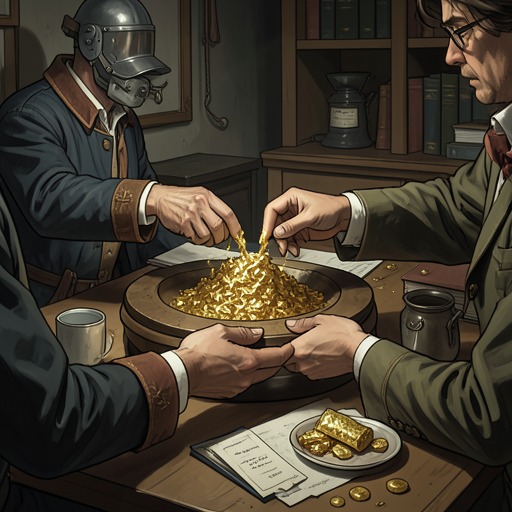
Ah Quee retorted the recovered dust into squares and stamped them with the name Aurora so that their value would be credited against his claim. He worked on the dresses over several months, taking advantage of Anna’s opium-induced unconsciousness when she visited his hut in Kaniere Chinatown. He emptied four gowns; the gold in Anna’s orange dress remained until she found it after waking in gaol, with no memory of the twelve hours before her arrest. The stamp thus gave the stolen and concealed gold an apparent mining provenance, even though its immediate source was the clothing.
Claim, labor, and concealment
By the time Ah Quee was extracting the gold, the Aurora claim had been purchased by Emery Staines. Staines received the retorted squares as Ah Quee’s legal earnings but did not bank them against the claim, as he was required to do. Instead, he bagged the gold, carried it to the Arahura Valley, and buried it. His later testimony confirms both the route of the gold and the deliberate concealment: what could have appeared in the mine’s accounts as a substantial return became part of the fortune hidden at Wells’s cottage.
The mine’s reported fortunes shifted as ownership and employment changed. Ah Quee’s indenture document was amended to replace Aurora with Dream of England as his present place of employment. Dick Mannering then asserted that the Aurora belonged to him and claimed Ah Quee as his worker again. The exchange shows the claim not simply as a site of extraction but as a point of leverage over a laborer whose contract and assigned workplace could be altered by others.
Apparent failure and narrative significance
Because Staines did not record Ah Quee’s gold against the claim, the Aurora appeared far less productive than it would have been had the metal been banked. The novel presents it as a claim that seemed to have collapsed in production, and its return to the bank forms part of the changing circumstances surrounding Ah Quee’s employment. Yet the hidden gold, if entered properly, would have transformed the mine from a duffer into a homeward-bounder. The gap between apparent failure and concealed wealth is therefore not geological evidence of an exhausted claim; it is the consequence of deception and missing accounts.
The Aurora’s name also exposes the instability of the gold’s identity. Ah Quee’s stamp makes the dresses’ contents look like mine proceeds; Staines’s concealment removes them from the claim’s records; and the discovery of gold in Wells’s cottage turns the question of ownership into a matter of inheritance and evidence. The mine is a real Kaniere claim, but within the plot it also functions as a false or incomplete explanation for a fortune whose movement connects Ah Quee’s labor, Anna’s clothing, Staines’s secret, and Wells’s hidden wealth.